|
At another place in the not too distant past, a statement by NASA Headquarters official Doug Stanley this past weekend would have been seen as nothing short of doom for America's future in space.
"We're never going to operate another space system," Stanley said.
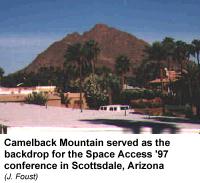 However, Stanley's pronouncement at the Space Access '97 conference in Scottsdale, Arizona, April 25-27 became one of the most popular statements of the conference, as it showed the space agency was serious in getting out of space operations and replacing its efforts with private industry, with hopes of reducing the cost of space access and increasing the size of the market. However, Stanley's pronouncement at the Space Access '97 conference in Scottsdale, Arizona, April 25-27 became one of the most popular statements of the conference, as it showed the space agency was serious in getting out of space operations and replacing its efforts with private industry, with hopes of reducing the cost of space access and increasing the size of the market.
Over 100 people attended the weekend-long conference, which featured presentations and panel discussions from industry leaders, consultants, and others who are focusing on ways to grab a share of the increasing market for space access by offering launches on a number of different systems for prices far lower that what is commercially available today. The conference made it clear that the technical problems with offering low-cost access to space were now secondary to concerns with financing the development and production of launch vehicles, and improving the uncertain regulatory environment needed to license and legally fly new the new launchers.
Commercial Launch Systems
Much of the conference examined the current status of several small, private launcher efforts, all of whom are trying to provide low-cost access to space. The focus of the small launchers is on the growing market for small (1000 kg or less) communications satellites in low-Earth orbit, where satellite constellations such as Teledesic and Globalstar will require the launch of hundreds of such satellites for their initial configurations, as well as eventual replacements and upgrades. The companies present at the conference took a wide range of approaches to provide launch services.
Michael Kelly of Kelly Space and Technology provided an update on their plans for a reusable launch vehicle named the Eclipse. The Eclipse will be towed behind a jet (likely a 747) like a glider to 12,000 meters (40,000 feet). At that altitude the Eclipse's engines will fire, the tow line will be released, and the spacecraft will fly a suborbital trajectory, releasing its payload near the peak of its trajectory before gliding back to Earth for a landing.
Kelly provided several updates to the project since it was unveiled six months ago, when the company won a contract from Motorola for 10 launches of replacement Iridium satellites. The company has conducted several flight tests and will start tests using a C-141 (as the tow aircraft) and a QF-106 (representing the Eclipse vehicle) this June. The company plans flights of two precursor versions of the Eclipse vehicle, the Eclipse Sprint and Eclipse Express, in early and late 1998 respectively. The full-scale version, the Eclipse Astroliner, will begin flights in the first quarter of 2000.
 One recent change with the Astroliner is the addition of a two-person crew to fly the vehicle. Kelly noted that there were a number of regulatory problems with a remotely-piloted vehicle, and a crew provides additional flexibility for the mission. Kelly said company engineers were considering adding a pair of turboprop engines that would be deployed as the Astroliner returned to Earth to allow a powered landing. Such engines could also assist during takeoff and allow crews to ferry the vehicle from site to site without another airplane. One recent change with the Astroliner is the addition of a two-person crew to fly the vehicle. Kelly noted that there were a number of regulatory problems with a remotely-piloted vehicle, and a crew provides additional flexibility for the mission. Kelly said company engineers were considering adding a pair of turboprop engines that would be deployed as the Astroliner returned to Earth to allow a powered landing. Such engines could also assist during takeoff and allow crews to ferry the vehicle from site to site without another airplane.
Mitchell Burnside Clapp of Pioneer Rocketplane discussed Pathfinder, a proposal similar to the Eclipse. Like the Eclipse, the Pathfinder would take off and land horizontally and use a rocket engine fired at altitude to fly a suborbital trajectory. Unlike the Eclipse, though, the Pathfinder would take off like an ordinary jet, using two jet engines like those used in fighter planes. The plane would climb to 9,000 meters (30,000 feet), where it would meet up with a tanker plane and take on a load of liquid oxygen. The Pathfinder would then fire its engines and fly a suborbital trajectory, returning to Earth using its jet engines for a powered landing.
Clapp emphasized the possibilities for point-to-point transportation with the Pathfinder, which could run intercontinental flights in an hour or less. With the first flight planned in about two and a half years and the company actively in search of funding, Clapp said the company was "sort of where we need to be."
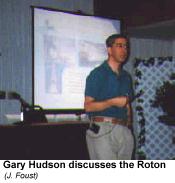
Gary Hudson of the Rotary Rocket Company (formerly HMX) gave an update on the Roton project, an effort to construct a reusable vertical takeoff and landing spacecraft which would use a combination of rocket engines and rotors. Hudson said the company was in confidential discussions with other companies, so he could not provide many new details on the Roton other than the company was planning flight tests "before the end of the century."
One interesting, if somewhat controversial, project presented at the conference was Advent Launch Service's proposal for suborbital flights specifically oriented towards space tourism. Their proposal calls for a vertical launch of a rocket, named CAC-1, from a barge floating in the Gulf of Mexico offshore of Galveston, Texas. The vehicle would fly up to over 110 km (70 mi.) above the Earth, reaching speeds of 3800 kmph (2300 mph) before gliding back to Earth for a horizontal water landing. The vehicle is specifically designed as a competitor for the X Prize, according to company founders Jim Akkerman and Harry Dace.
Some conference attendees expressed concern with their funding model, where people do not buy tickets on the launcher but $3,500 memberships in a non-profit group, the "Civilian Astronauts Corps" . This is designed to shift liability for any launch accidents from the company to the non-profit group, although some attendees believed that the liability concern still exists. Some expressed doubts about the ambitious schedule for the launcher, which calls for a first flight in mid-1998, if the company can round up the $5 million in funds needed to start construction of the vehicle.
Although the conference emphasized new reusable launch vehicle proposals, expendable launchers were not left out of discussions. George Herbert of Retro Aerospace announced his company's new Breeze launcher, a small, simple expendable launcher designed to place small satellites into orbit for $2,000 a pound, half the cost of current small launchers. The Breeze would use four stages powered by nitric acid and kerosene engines to place 1100 kg (2,500 lbs.) into low-Earth orbit. Herbert said the Breeze would be available for commercial launches in early 1999, if funding can be secured by later this year.
NASA/DoD Programs
While a number of small companies are providing an array of new, low-cost launch options, the federal government (both NASA and the Department of Defense) and the major aerospace corporations still play the role of the 800-lb. gorilla which can make or break the efforts of the smaller firms. Thus, there was considerable interest in several presentations on the X-33 project and plans for future X vehicles.
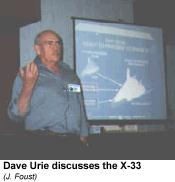 Dave Urie, a consultant for Lockheed Martin for the X-33, gave an update on the SSTO technology demonstrator. While not acknowledging rumors that the vehicle was up to 35% overweight and the aerospike engines were suffering from problems, he did note that any problems with the vehicle "involve working with a diverse team and still working together to produce a vehicle," he said. Dave Urie, a consultant for Lockheed Martin for the X-33, gave an update on the SSTO technology demonstrator. While not acknowledging rumors that the vehicle was up to 35% overweight and the aerospike engines were suffering from problems, he did note that any problems with the vehicle "involve working with a diverse team and still working together to produce a vehicle," he said.
Lockheed Martin is planning a series of test flights from Edwards Air Force starting in July 1999, including two short-range flights, up to ten medium-range flights to Utah, and three or more flights to Montana. Even if the vehicle is lost during an early test flight, Urie said the project would still have achieved "eighty percent" of its goals. Urie also said the results of the flight tests would be made public, and there were no plans for any commercial use of the X-33 vehicle itself, instead using the vehicle as a test of whether to proceed on the full-scale VentureStar vehicle.
Doug Stanley of NASA headquarters discussed NASA's "Future-X" project, a follow-on to the X-33 and X-34 experimental vehicle programs. Stanley said NASA's interest was focused on two types of programs: focused technology projects named "Pathfinder" which would test specific new technologies, and integrated system projects named "Trailblazer". Examples Stanley gave of Pathfinder projects included aerobraking demonstrations, tests of in-flight cryogenic fuel transfer, and new airbreathing engine tests. Trailblazer tests include a possible upgraded X-33, a reusable upper-stage demonstrator, and even a possible heavy-lift expendable.
Stanley said that any X-vehicle program NASA selected needed a consistent approach to develop space transportation technology and an industry-led partnership. He also said that NASA was interested in taking another look at airbreathing propulsion, and are seriously considering making the next major X-vehicle capable of reaching orbit to perform additional tests.
The problem with NASA's plans, Stanley said, is that funding "falls off a cliff" after X-33. However, NASA is planning to increase funds for X-vehicle projects after the year 2000, aiming for a goal of $600 million a year. Of that amount, $100 million would be spent on Pathfinder projects, $150 million of technology development, and $350 million on Trailblazer projects. This would be in addition to any money Congress approves for another X-vehicle, as the House approved in HR 1275 in April.
Air Force Captain John Antonnen reported on plans at the Phillips Lab to develop an integrated technology testbed for a possible future military spaceplane. The two phase project would start with $10 million in multiple contracts to develop the testbed and conduct ground tests. A second phase would award $130 million for a series of tests of key components and assemble as many parts of a vehicle as possible, although there would be no attempt to actually fly the vehicle or develop propulsion systems.
Finance and Regulatory Issues
While there was a general consensus that technical issues regarding low-cost access to space had been resolved or else could be taken care of, a greater issue for many of the new start-up companies is finding the money to finance their efforts.
G. Harry Stine reprimanded many of the people attending the conference for focusing too much on technical issues and not enough on financial ones. "We are not talking to the industrialists and financiers in a language they understand," he said, repeating the same words he spoke at a conference 21 years ago. "No one listened [then]," he said.
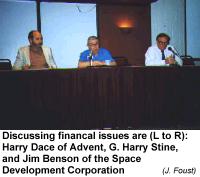 "Very few people in the finance community understand this field," said merchant banker Paul Hans. He recommended that potential entrepreneurs spend time understanding the world of finance, including a basic understanding of accounting and current news in the world of finance. "Very few people in the finance community understand this field," said merchant banker Paul Hans. He recommended that potential entrepreneurs spend time understanding the world of finance, including a basic understanding of accounting and current news in the world of finance.
Hans also noted that investors usually work with a 5-year horizon, and expect to get at least a 15 to 20 percent return, and perhaps as much as 30 to 50 percent for risky businesses such as new launch ventures.
"People will give you money because you have delivered," he said, "not because of your dreams."
Another major concern for space entrepreneurs is the uncertain regulatory environment. Many of the necessary regulations for regular commercial access to space, such as the appropriate certification for reusable launchers, have yet to be written. Members of one panel feared that without input from the industry, the Federal Aviation Administration would make up regulations on their own that could be unfriendly to commercial interests.
There was considerable interest among many conference attendees to work on lobbying the government for commercial-friendly regulations. "There is a remarkable opportunity for civilian advocacy to get involved," advised aerospace lawyer Les Tennen.
"We need to get started now," said Henry Vanderbilt, executive director of the Space Access Society and conference organizer. "We can't put it off for another year." More information about any lobbying efforts was expected to be announced in the near future.
X-Prize founder Peter Diamandis summarized the problems with finance and regulations by saying, "It's no longer technical issues which hold us back; it's the investment and regulatory issues."
Space Tourism
One field which may provide the financial impetus to expanded cheap access to space is space tourism. Interest in tourist flights into space is growing as more possibilities for inexpensive access to space become available.
Rand Simberg of Interglobal Space Lines reported on the space tourism workshop run by NASA and the Space Transportation Association, held earlier this year. He said the idea of space tourism has moved beyond the "giggle factor" and more travel and tourism professionals are becoming interested in the concept.
Describing space tourism as "the key enabler for all future space activities," he outlined a number of precursor activities a working group he chaired at the meeting suggested. Those activities included market research studies, education of potential space tourism markets, and the creation of a trade organization to build awareness about the concept and stimulate long-term thinking.
Space tourism consultant Sam Coniglio reported on the first major space tourism conference, which was held in Germany in March. He said the current major problem with space tourism was the legitimacy factor, and noted the need to get tourism professionals on board. He reported on his efforts to get Disney involved by agreeing to some new space exhibits at the EPCOT Center in Florida.
If the field can be legitimized, Coniglio believes, the market will appear. He noted that worldwide spending on "adventure" tourism, such as safaris and mountain-climbing expeditions, was $324 billion in 1996. Studies in the United States and Japan show people would be willing to spend $10,000 to $20,000 for even brief trips into space.
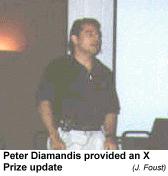 Peter Diamandis expressed his hope that the $10 million X Prize he founded will help inspire companies to develop launch vehicles for the tourism market. The rules of the prize are designed to encourage the development of vehicles that could be used for space tourism applications, by requiring a crew of three people and reusability and fast turnaround. Peter Diamandis expressed his hope that the $10 million X Prize he founded will help inspire companies to develop launch vehicles for the tourism market. The rules of the prize are designed to encourage the development of vehicles that could be used for space tourism applications, by requiring a crew of three people and reusability and fast turnaround.
Diamandis said 14 teams have signed on, and he expects more than 20 after the prize sponsor is announced. Diamandis is still working to raise money for the X Prize, although the foundation has already received more than $1 million, largely from the St. Louis community, to support its operations.
By the close of the conference late Sunday afternoon, it was clear that there was considerable enthusiasm for low cost, commercial access to space which could meet the needs of businesses from high-speed transport to space tourism. While not all of the ventures would succeed (Stine said that of 20 ventures that start, only one will succeed) the motivation and momentum needed to make the best possible effort was in place. With a little time and a lot of hard work, cheap access to space may soon become a reality.
|
