|
A researcher at Purdue University has developed a theoretical technique for getting from one region of the solar system to another with a minimum of fuel by "surfing" from libration point to libration point.
![[image of SOHO spacecraft]](images2/soho.jpg) Kathleen Howell, a professor in the aeronautics and astronautics department at Purdue, has found that libration points -- specific points in space formed by the interaction of the gravitational fields of the Sun, planets, and moons -- have two-dimensional "surfaces" associated with them. Any object, such as a spacecraft, that reaches these surfaces will be guided into orbits around the libration points. Kathleen Howell, a professor in the aeronautics and astronautics department at Purdue, has found that libration points -- specific points in space formed by the interaction of the gravitational fields of the Sun, planets, and moons -- have two-dimensional "surfaces" associated with them. Any object, such as a spacecraft, that reaches these surfaces will be guided into orbits around the libration points.
"It's kind of like a marble rolling in a funnel," she said. "All I have to do is get on the sheet and I can 'ride' to a libration point. We can also 'shift' from one sheet to another to get to a destination, not necessarily a libration point."
Howell said that these gravitational surfaces could be used to dramatically lower the cost of launching spacecraft to explore the solar system.
"Instead of launching five individual spacecraft from Earth, which is expensive, we could launch five spacecraft all in one craft and send them to a particular libration point orbit," she said. "From there, it would take much less fuel to send each craft off in a different direction, to other libration point orbits or possibly to other planets."
Libration points are already used by some spacecraft, such as the SOHO and WIND spacecraft, which use the L1 point between the Earth and the Sun to provide a stable location to monitor the Sun and the Earth's magnetic field.
|

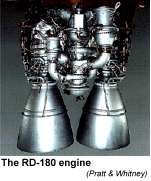 Pratt and Whitney (P&W) and NPO Energomash (NPO-EM) announced on February 4 the creation of RD AMROSS, LLC, a Florida-based joint venture. The new company will market a version of the
 ![[illus. of Teledesic spacecraft]](images2/teledesic.jpg) Teledesic is looking at the Dnepr, a converted SS-18 ICBM, to launch as many as 200 of its over 900 satellites over the next several years.
Teledesic is looking at the Dnepr, a converted SS-18 ICBM, to launch as many as 200 of its over 900 satellites over the next several years.